
Was the Constitution Really Based on the Bible? A debunking of the “Lutz study” lie.

I guess since this is my first post here on my shiny new substack, I should introduce myself to people who have no idea who the hell I am.
I’ve been debunking David Barton’s lies about American history for over 23 years. I published my first book, Liars For Jesus: The Religious Right’s Alternate Version of American History, Vol. 1, in 2006, in which I debunked a slew of Christian nationalist history lies — from tales early Congresses printing Bibles for schools to prayers at the Constitutional Convention to a plethora of lies about Thomas Jefferson, and much, much more.
That first Liars For Jesus book led to an invitation to blog about history revisionism on Talk2Action, where a post I wrote in May of 2007 about David Barton’s lies appearing in the JROTC curriculum’s American history textbook led to my working for the Military Religious Freedom Foundation (MRFF) as the foundation’s research director, where I still am almost 19 years later, battling the evil forces of Christian nationalism within our military.
In January 2016, I finally published the second volume of Liars For Jesus. This second volume included all the crap I’d already debunked that I couldn’t cram into the first volume as well as some new lies that had become popular in the decade that had elapsed since I published the first volume.
Given the present state of our country, with Christian nationalists at the highest levels of our government, a president who has welcomed David Barton into the Oval Office to pray over him, and more Christian nationalist lies being repeated by members of Congress than ever before, I’ve decided to get back into the history game. I’ve already begun working on a new book, but given that it took me 10 years to get the second volume of Liars For Jesus finished, you might not want to hold your breath waiting for a new book from me. But in the meantime, there is Substack, so here I am.
For my first post here, I’ve decided to address the most fundamental claim of Barton and the other Christian nationalists — that our Constitution was based on the Bible.
At the core of this overarching claim is a study of eighteenth century writings published in 1984, commonly known as the Lutz study, which has been twisted, mangled, and cherry-picked by Christian nationalist history revisionists for nearly four decades as a big chunk their “evidence” that the Constitution was based on the Bible.
What follows is the chapter titled “Was the Constitution Really Based on the Bible?” from the second volume of my Liars For Jesus, in which all the lies about the Lutz study are thoroughly debunked.
Not in the mood to read a 12,000-word book chapter? Don’t worry. I’ve got you covered. I also did a shorter, but still pretty thorough, debunking of the Lutz study lie back in 2010 as part of my “No, Mr. Beck …” video and blog post series, a series of debunkings that I did when Barton was regularly appearing on his pal Glenn Beck’s old Fox News show’s “Founders Fridays.” You can read this shorter 2010 version on HuffPost or Talk2Action or even just watch the video. (Feel free to skip the beginning with my guitar playing and wardrobe change. I won’t be offended.)
So, let’s get down to some history lie debunking. Let the games begin!
Was the Constitution Really Based on the Bible?
Liars For Jesus, Vol. 2 (2016)
In an April 2007 article on WorldNetDaily titled “Bringing the Bible Back Into Public Schools,” National Council on Bible Curriculum in Public Schools (NCBCPS) board member and spokesman Chuck Norris (yes, that Chuck Norris) regurgitated the following erroneous claim, almost verbatim from the NCBCPS website’s “Founding Fathers” page:
A study by the American Political Science Review on the political documents of the founding era, which was from 1760- 1805, discovered that 94 percent of the period’s documents were based on the Bible, with 34 percent of the contents being direct citations from the Bible. The Scripture was the bedrock and blueprint of our Declaration of Independence, our Constitution, academic arenas and heritage until the last quarter of a century.
The study referred to by Norris, usually referred to as the Lutz study, was conducted by political science professors Donald S. Lutz of the University of Houston and Charles S. Hyneman of Indiana University. The study’s findings were published by Lutz in a 1984 article in The American Political Science Review titled “The Relative Influence of European Writers on Late Eighteenth Century American Political Thought.”
Misrepresentations of the Lutz study began appearing in 1987, just three years after Lutz’s 1984 American Political Science Review article, with various versions now being found not only in the writings of NCBCPS spokesman Chuck Norris and the books of NCBCPS advisory board member David Barton, but in the NCBCPS curriculum itself (which quotes the version from Barton’s book Original Intent nearly verbatim), and even in a resolution introduced in the United States House of Representatives. One currently popular variation, promoted by Barton and his partner in crime Glenn Beck, has many Americans believing that our Constitution was based on the Book of Deuteronomy. But, before getting to all of these variations on a theme, let’s first take a look at how the findings of the Lutz study were initially distorted to create the core of the lie.
The basic lie – that “The Bible accounted for 34 percent of all the Founder’s [sic] quotes,” as David Barton put it in his book The Myth of Separation – was created by selectively using one of the charts found in Lutz’s American Political Science Review article, but completely ignoring Lutz’s explanation of what the findings presented in that chart actually meant.
Here is the chart that the 34 percent figure comes from:
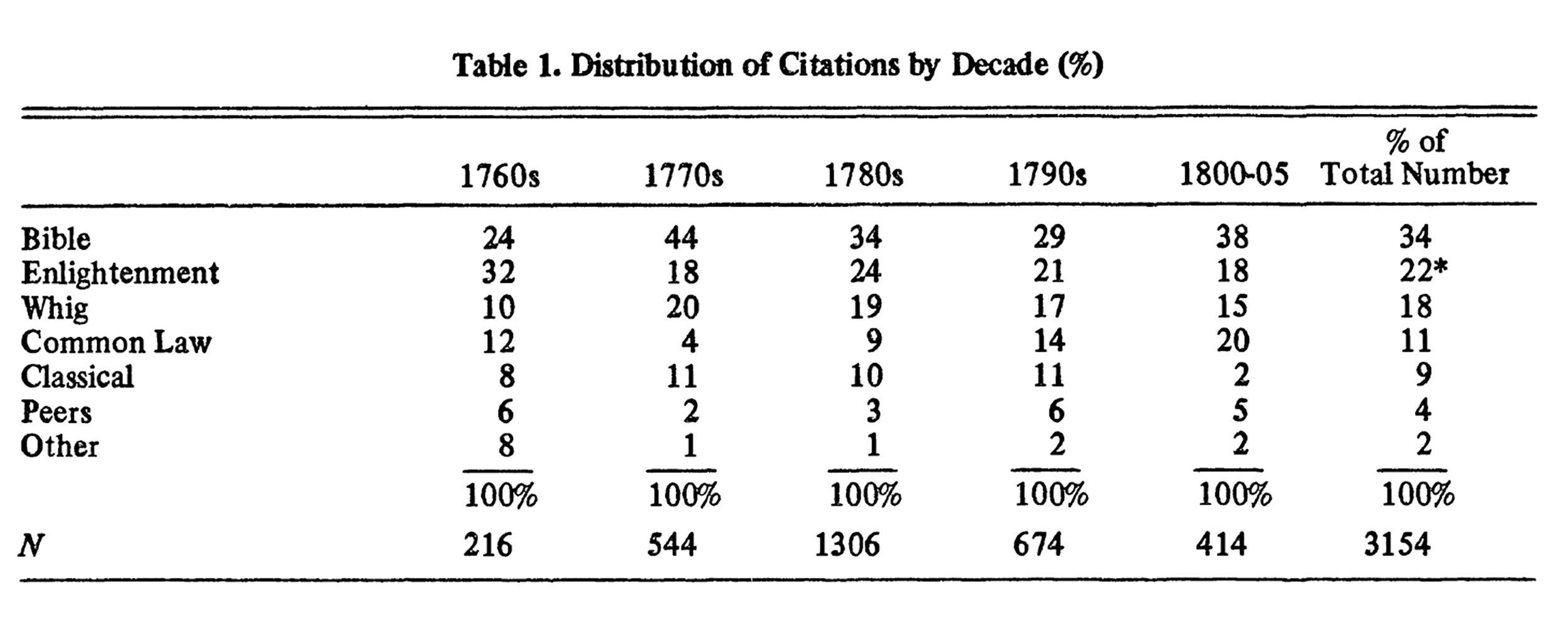
Looking only at this one chart, which is all the revisionists want you to look at, it really does appear that 34 percent of the citations in the items studied came from the Bible. And that’s because they did. But, as Lutz explained in his article, there was a reason that this number was so high, and by simply omitting Lutz’s explanation of what this reason was, this chart is easily misrepresented by the revisionists to support their claim that the Bible accounted for 34 percent of all the founders’ quotes.
So, what was the reason for the number of biblical citations being so high? Well, it was that most of the biblical citations came from sermons, as Lutz clearly explained:
...From Table 1 we can see that the biblical tradition is most prominent among the citations. Anyone familiar with the literature will know that most of these citations come from sermons reprinted as pamphlets; hundreds of sermons were reprinted during the era, amounting to at least 10% of all pamphlets published. These reprinted sermons accounted for almost three-fourths of the biblical citations...1
So, almost three-fourths of that 34 percent total came from one particular type of document included in the study – printed sermons – and “anyone familiar with the literature,” as Barton incessantly claims to be, would know this. Barton would also know this because Lutz said it right there in his article. He just chooses to ignore this inconvenient explanation – one of the several lies by omission that are necessary for his distortion of the Lutz study to work.
Obviously, the fact that three-fourths of the biblical citations came from sermons bumps the number of biblical citations way down (to about 9 percent) for all of the items in the study that weren’t sermons, which Lutz also clearly noted in his article, writing that this makes the “nonsermon source of biblical citations roughly as important as the Classical or Common Law categories.”2 In other words, for the writings that weren’t sermons, Enlightenment (22 percent) and Whig (18 percent) sources move from second and third places into the number one and number two spots, and the Bible is pushed down into the range of Classical sources.
But, of all the findings in the Lutz study ignored by Barton and the other revisionists, none are nearly as important as those found in the section of Lutz’s article titled “The Pattern of Citations from 1787 to 1788.”
As seen in the first chart, Lutz broke down the number of citations from all sources by decade. In addition to this, he also singled out in a separate chart the writings from 1787 and 1788, the crucial two-year period during which our government was actually being formed. Why do the revisionists completely omit this part of the study? Because Lutz and Hyneman found almost no biblical citations during this two year period when the Constitution was being written and debated in the press. And, on top of that, not a single one of the few biblical references they did find was in writings that were in support of the Constitution. They were all in writings by anti-federalists who were arguing against the Constitution. Obviously, this part of the study pretty much destroys the revisionists’ fundamental claim – that our Constitution was based on the Bible.
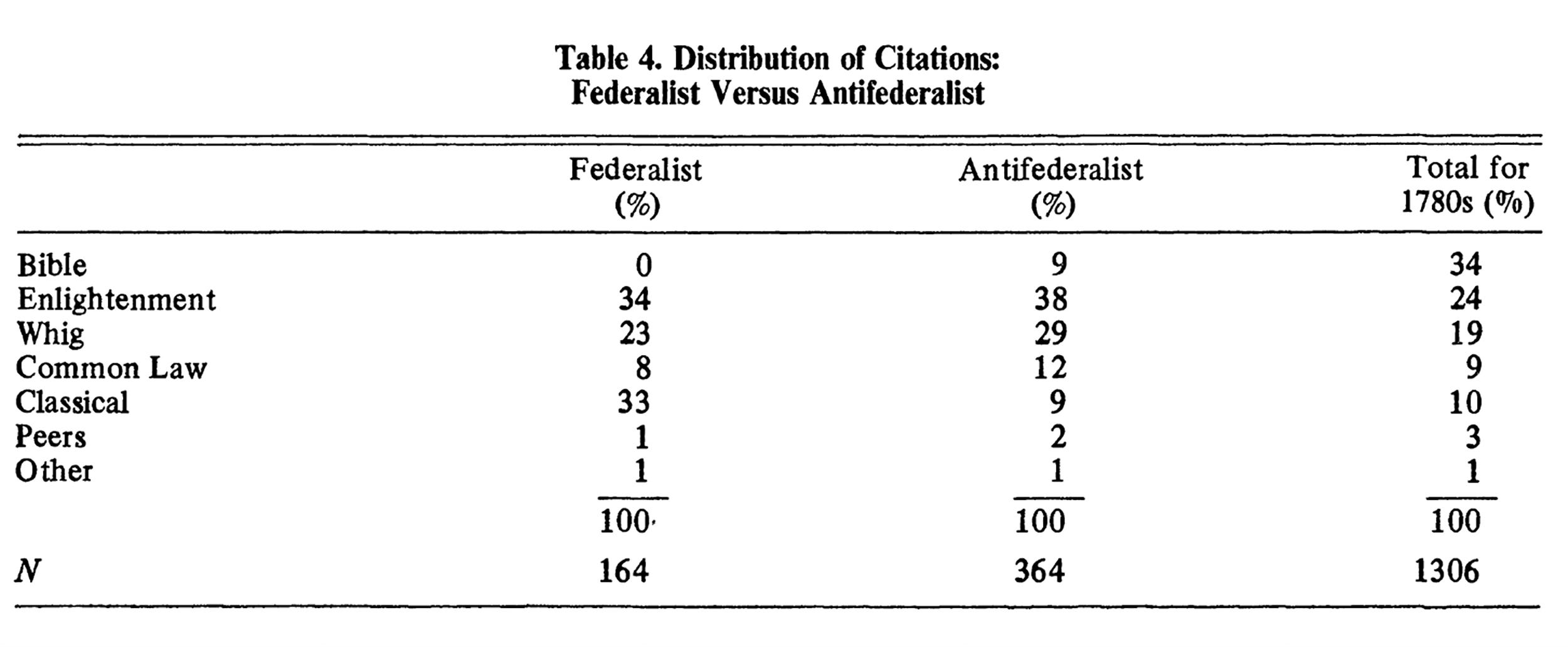
Lutz’s explanation of this almost complete absence of biblical citations during the period when the Constitution was being written and debated is even more problematic for the revisionists, who not only make the vague claim that the Constitution was based on the Bible, but claim that specific sections of the Constitution were based on specific passages from the Bible. David Barton, for example, claims that the founders got the idea to have three branches of government from Isaiah 33:22, which says, “For the Lord is our judge, the Lord is our lawgiver, and the Lord is our king,” and the idea for the separation of powers between the three branches from Jeremiah 17:9, which says, “The heart is deceitful above all things, and desperately wicked: who can know it?” Yes, there you have it – three branches of government from Isaiah 33:22, but they’re all “the Lord,” which is, of course, completely contradictory to a separation of powers, and Jeremiah 17:9 saying that men’s hearts are deceitful, which Barton claims was the “logic” behind the separation of powers. Around 2012, Barton began to go even further than merely claiming that the concepts in the Constitution were based on the Bible, making the completely ridiculous claim on his radio show and in his presentations that parts of the Constitution were taken “verbatim” from the Bible.
Now, look at the reason that Lutz gave in his article for the almost complete absence of biblical citations in the writings from the period when the Constitution was being written and debated:
The Bible’s prominence disappears, which is not surprising since the debate centered upon specific institutions about which the Bible has little to say. The Anti-Federalists do drag it in with respect to basic principles of government, but the Federalists’ inclination to Enlightenment rationalism is most evident here in their failure to consider the Bible relevant.3
So, here we have Donald Lutz explicitly saying that the reason for the lack of biblical citations during the time when the Constitution was being debated was that the Bible had little to say about the specific institutions of government that were being debated. On the other hand, we have David Barton claiming that specific parts of the Constitution came directly – even “verbatim” – from the Bible. You really can’t get more opposite than that. But that doesn’t stop Barton from citing the Lutz study when making this claim.
Before getting into any other examples of the ways in which the Lutz study is misrepresented, a somewhat more precise description of the items included in the study than Chuck Norris’s vague classification of their being “political documents” is needed.
The criteria used by Lutz and Hyneman in selecting their sample of what they called “political writings” were that the writings be more than two thousand words long, contain explicit political content, and have been printed for public consumption (i.e., items like pamphlets and newspaper articles, but not items like official documents, legislative proceedings, or personal correspondence). What Lutz and Hyneman were trying to determine was the familiarity among Americans of the time with various sources. As Lutz explained in his article, counting the citations in writings that were intended for the public was an effective way to determine this familiarity because a source being cited by an author indicated not only that the author themself was familiar with a source they were citing, but that the author assumed that their intended audience – the general public – would also be familiar with that source.
As you’ll see when we get into the other examples of how this study is misrepresented, most claim that the study included 15,000 documents. This is incorrect. The study included only 916 items, as Lutz clearly explained in his article. The 15,000 number is plucked from Lutz’s explanation of how the items for the study were selected. In their search of various archives and collections for the writings that would fit the criteria for their study, Lutz and Hyneman did initially look at 15,000 items. They did not, however, study all 15,000 of these items. That was just the number of items they sifted through to find the items that fit the criteria for their study. Out of the 15,000, they found and read closely only the 2,200 or so that contained explicit political content. Then, out of that 2,200, they chose their final sample for the study, which consisted of the 916 items with “the most significant and coherent theoretical content.” In other words, they had to sift through the many thousands of non-relevant items in the archives they were searching in order to find the political writings that ended up in their study sample.
So, why would a mainstay of the revisionists’ misrepresentations of this study be to constantly make a point of inaccurately saying that there were 15,000 items in the study when there were actually only 916? Why would the number of items that were included in the study make a difference? Well, for the same reason that David Barton constantly makes a point of boasting about how many footnotes his books have. The revisionists know that their audience is impressed by big numbers. Thirty-four percent of the citations in 15,000 “documents” (they use word “documents” because it sounds more official than Lutz’s word “items,” the more accurate word to describe what were items like newspaper articles and pamphlets and not official documents) just sounds like a whole lot more than 34 percent of the citations in 916 items, and makes it easier for them to give their audience the impression that all of the founders constantly cited the Bible in everything they wrote.
We now know what was included in the study, and that printed sermons with explicit political content were included because they obviously would have fit the study’s criteria of being more than 2,000 words long and being printed for public consumption. We also know that these sermons were the reason for the high number of biblical citations, accounting for three-fourths of the biblical citations that made up that 34 percent of biblical citations. So, how did Chuck Norris and the NCBCPS go from this already misrepresented 34 percent to “94 percent of the period’s documents being based on the Bible?” Well, no big surprise, this 94 percent claim comes from David Barton.
Barton took the other sources listed in the Lutz study, such as Locke, Montesquieu, and Blackstone, and then claimed that because some of these other sources derived their ideas from the Bible, the founders were indirectly quoting the Bible whenever they cited any of these other sources. He determined, by adding up the number of citations of these other sources, which are broken down in another chart in Lutz’s article, that an additional 60 percent of the citations found in the study came indirectly from the Bible, added that 60 percent to the already misrepresented 34 percent, and, voilà, a whopping “94 percent of the period’s documents were based on the Bible.”
Barton first made this 94 percent claim way back in 1990, in the first version of his video America’s Godly Heritage, in which he falsely attributed the 94 percent figure directly to Lutz and Hyneman, saying:
They found that 94 percent of the quotes of the founders were based on the Bible. 34 percent came directly out of the Bible, and another 60 percent were based from men who had used the Bible to arrive at their conclusions.
Barton’s claim that his 94 percent number came from the Lutz study is, of course, an outright lie. Lutz said nothing of the kind. But let’s take a look at it anyway.
Barton uses his misrepresentation of the Lutz study (whether he’s using the 34 percent version or his 94 percent version) to make a cause and effect claim – asserting that the founders’ use of the Bible is the reason they put certain specific things in the Constitution.
An example that has been consistently used by Barton, from the days of his earliest videos to his current books, videos, and presentations, is the one already mentioned – that three branches of government with a separation of powers between them came directly from specific Bible verses. Since this is an example that Barton still uses today, let’s use that same example here.
In his America’s Godly Heritage video, Barton immediately followed his lie that it was Lutz and Hyneman who said that 94 percent of the quotes of the founders were based on the Bible with this:
Now, that leads to a lot of interesting things that we have in our government now. For example, we’ve got things that make us very unusual for other nations in the world. We established two hundred years ago three branches of government, and those three branches of government that our founders set up were quite unlike any other nations around them. They didn’t copy Britain’s. They didn’t copy France. Where did they get the ideas for our three branches of government that we have now? And, on top of that, when the founding fathers established those three branches they put in constitutionally guaranteed separation of powers to keep each branch away from the others. Well, the idea for the three branches of government came from Isaiah 33:22 and the idea for the separation of powers the founders found in Jeremiah chapter 17.
Let’s start with the three branches of government, which Barton claims the founders got from Isaiah 33:22 – “For the Lord is our judge, the Lord is our lawgiver, and the Lord is our king.” Because he needs to leave no possibility other than the Bible to explain where the founders could have gotten this idea, Barton claims that the concept of having three branches of government was unlike any other government that existed, and even says, “They didn’t copy Britain’s.” The problem with this part of Barton’s claim, of course, is that Britain did have three branches of government – an executive branch (the king and his Privy Council, which by the time of the founders was known as the Cabinet), a legislative branch (the Parliament), and a judiciary – and the founders did copy that. It wasn’t a new American idea. It’s what existed in England, was brought over to the colonies, and was naturally going to be the set-up of the federal government.
The concept of a separation of powers wasn’t a new American idea either. Britain’s government also had a separation of powers. And that is where we get to Montesquieu, one of the sources listed in the Lutz study whom Barton claims derived his ideas from the Bible, and that, therefore, whenever the founders cited Montesquieu it was the same as their citing the Bible.
Montesquieu was by far the most frequently cited source during the period when the Constitution was being written and debated, mainly because of two big issues. One was the argument from the anti-federalists that a republic could only work for a very small territory, and not for a large nation. This is what Montesquieu believed, so, for that argument, the anti-federalists invoked Montesquieu to argue against the Constitution. The other was how, or if, the Constitution’s separation of powers would work. In that debate it was the federalists who had Montesquieu on their side. So, citations of Montesquieu would have included both positive and negative citations (which the Lutz study made no distinction between) from both sides on both of these major issues, resulting in a lot of citing of Montesquieu.
To be more specific about what it was that the founders were citing when they invoked Montesquieu in the debate over the separation of powers, it was Montesquieu’s The Spirit of the Laws, published in 1748. To be even more specific, it was Book XI (“Of The Laws which Establish Political Liberty, with Regard to the Constitution”), Chapter 6 (“Of the Constitution of England”).
What Barton can’t let his readers know is that Montesquieu was writing about something that already existed in other governments, for the reason already explained – he needs the separation of powers to have been a brand new concept exclusive to America in order for his claim that the founders got the idea from Jeremiah 17:6 to work. In his book Original Intent, he does a couple things to accomplish this.
First of all, he simply doesn’t mention that Montesquieu’s chapter was titled “Of the Constitution of England,” since that would be a dead giveaway that Montesquieu was writing about something that already existed in Britain.
Second, he diverts his readers’ attention with three quotes from people other than Montesquieu, editing two and selectively quoting one to make them fit his claim that the separation of powers was something completely unprecedented that the founders came up with because of Jeremiah 17:9.
The first of these quotes comes from John Quincy Adams. What Barton does here is to selectively quote only this one sentence:
At the time of the Declaration of Independence, Montesquieu was one of the most recent and esteemed writers upon government, and he had shown the division of powers to be essentially necessary to the preservation of liberty.
What Barton ignores, because it says that having three branches of government was something that was well established long before the writing of the Constitution, is this sentence, which immediately preceeds the sentence that he selectively quotes:
The division of the offices of government into legislative, executive, and judicial, had long been established in the British colonies, though not very effectively settled in their organization.4
While what Barton quotes from John Quincy Adams is not in itself an inaccurate quote, and would not be deceptive under other circumstances, it is definitely selective quoting in this case given that Barton, in everything he writes or says on this subject, consistently omits the same thing – anything that says that the concept of having three branches of government was not a new invention in the Constitution, but was what existed in Britain and was brought over from Britain to the America colonies.
Barton next quotes from the beginning of Montesquieu’s chapter on the separation of powers, but only after having led his readers to believe that this was merely one of Montesquieu’s “political theories” rather than something that already existed in Britain and elsewhere. The short passage that Barton quotes is, of course, one that doesn’t contain anything indicating that Montesquieu was writing about what already existed in Britain.
Since neither Barton’s quote from John Quincy Adams nor what he quotes from Montesquieu is actually a misquote, some might argue that Barton’s failure to include what Adams wrote in the sentence before the one he quotes or his failure to mention what the title of Montesquieu’s chapter was don’t necessarily mean that he deliberately omitted these things for any particular reason. But, when you put those omissions together with the next quote presented by Barton, which is absolutely a misquote, and look at what he specifically edits out of that quote, there can be little doubt that these are all deliberate omissions with the same goal.
After writing that “The separation of powers theory is rooted in the Biblical concept espoused in Jeremiah 17:9 that man naturally tends toward corruption,” Barton quotes George Washington, claiming that:
George Washington, in his “Farewell Address,” confirmed that the Biblical teaching on the condition of the heart was sufficient reason for maintaining the separation of powers:
A just estimate of that love of power, and proneness to abuse it, which predominates in the human heart is sufficient to satisfy us of the truth of this position. The necessity of reciprocal checks in the exercise of political power; by dividing and distributing it into different depositories ... has been evinced [established].
Now, look at the complete second sentence of what Barton quotes, and what he chopped off (emphasis added):
The necessity of reciprocal checks in the exercise of political power; by dividing and distributing it into different depositories, and constituting each the Guardian of the Public Weal against invasions by the others, has been evinced by experiments ancient and modern; some of them in our country and under our own eyes.5
See what Barton chops off there? He cuts off Washington’s sentence right before the part that says “by experiments both ancient and modern; some of them in our country and under our own eyes,” once again omitting the words that would reveal to his readers that the separation of powers was something that existed in other governments before the formation of the United States government. Can anyone doubt that Barton is deliberately trying to hide this fact from his readers when he is systematically omitting from every example and quote that he presents on the subject anything that would reveal this particular fact?
Barton next quotes Alexander Hamilton, writing:
Alexander Hamilton cited the same truth concerning the human heart:
Why has government been instituted at all? Because the passions of men will not conform to the dictates of reason and justice without constraint. ... [T]he infamy of a bad action is to be divided among a number than ... to fall singly upon one.
First of all, this quote from Alexander Hamilton had nothing to do with the separation of powers, let alone the Bible verse that Barton claims it was based on. It’s from Federalist No. 15, in which Hamilton was making the argument for why a stronger federal government was needed than what existed under the Articles of Confederation, which could only make requests of the states but had no real power to enforce any of the resolutions it passed.
In the beginning of the paragraph from which Barton plucks his butchered quote, Hamilton was pointing out that experience had proven that the individual states would not always comply with the existing federal government simply out of a sense of common interest with the rest of the states, as it had once been thought they would. It was in this context that he then asked the question, “Why has government been instituted at all?” As part of his answer to that question, he said that an individual would be more likely to go along with a “bad action” as part of a group (e.g., a state legislature or a faction within a legislature) than they would be to publicly condone that action on their own. This, Hamilton chalked up to nothing more than an individual’s concern for their own reputation. And where did Hamilton say he got this idea? Was it the Bible? Jeremiah 17:9? Well, no. Hamilton said it was “the best oracle of wisdom, experience.” He was basing his opinion on actual events that had taken place under the Continental Congress and the Articles of Confederation.
Here is Hamilton’s entire paragraph from Federalist No. 15, with the part chopped out by Barton from the snippet of the paragraph that he quotes in bold:
There was a time when we were told that breaches by the states, of the regulations of the federal authority, were not to be expected; that a sense of common interest would preside over the conduct of the respective members, and would beget a full compliance with all the constitutional requisitions of the union. This language, at the present day, would appear as wild as a great part of what we now hear from the same quarter will be thought, when we shall have received further lessons from that best oracle of wisdom, experience. It at all times betrayed an ignorance of the true springs by which human conduct is actuated, and belied the original inducements to the establishment of civil power. Why has government been instituted at all? Because the passions of men will not conform to the dictates of reason and justice, without constraint. Has it been found that bodies of men act with more rectitude or greater disinterestedness than individuals? The contrary of this has been inferred by all accurate observers of the conduct of mankind; and the inference is founded upon obvious reasons. Regard to reputation has a less active influence, when the infamy of a bad action is to be divided among a number, than when it is to fall singly upon one. A spirit of faction, which is apt to mingle its poison in the deliberations of all bodies of men, will often hurry the persons, of whom they are composed, into improprieties and excesses, for which they would blush in a private capacity.6
But Barton’s readers will, of course, believe him when he says that these quotes from Washington and Hamilton are proof that these two founders “confirmed that the Biblical teaching on the condition of the heart was sufficient reason for maintaining the separation of powers.”
So, how did Barton hit on Jeremiah 17:9 as the specific Bible verse to claim as the “logic” behind the separation of powers? Well, he doesn’t say, other than saying that it was “a verse that had been the subject of numerous sermons during the founding era.”
In the episode of his American Heritage Series TV show titled “Our Biblical Constitution,” he shows a clip from one of his other videos, The Role of Pastors & Christians in Civil Government, in which he says:
In fact, signers of the Constitution George Washington and Alexander Hamilton confirmed that the separation of powers was based on the biblical principle found in Jeremiah 17:9, a verse that had been the subject of numerous sermons during the founding era.
The book version of The Role of Pastors & Christians in Civil Government, which is a nearly verbatim transcription of the video, naturally contains an astounding number of endnotes – thirteen pages filled with 159 endnotes for a book that only has thirty-six pages of actual text. There’s an endnote for his claim that Washington and Hamilton “confirmed that the separation of powers was based on the biblical principle found in Jeremiah 17:9,” which cites the same two quotes that he misquotes in Original Intent. But what isn’t there an endnote for? Those numerous sermons from the founding era that he claims turned the founders on to this verse from Jeremiah. You’d think that, if there were so many sermons connecting Jeremiah 17:9 to the separation of powers, Barton would include an endnote listing some of those sermons, right? But he doesn’t provide even a single example.
If you search for Jeremiah 17:9 in sermons of the founding era, you can certainly find this verse quoted in quite a few sermons, just as you can find lots of other Bible verses if you search a whole bunch of sermons looking for a particular verse. But, in all the sermons I can find that quote Jeremiah 17:9, this verse is quoted in contexts such as “the true reasons why people neglect to come to the Holy Sacrament,” admonitions against trusting one’s deceitful heart because it is good at “making people believe they are going to heaven when they are going the straight road to hell,” and how a deceitful heart can make people susceptible to arguments that make them doubt the truth of Christianity. So, saying that this verse was “the subject of numerous sermons during the founding era,” as Barton does, isn’t untrue. But he doesn’t provide a shred of evidence to support his claim that this verse had anything to do with the founders’ reason for putting a separation of powers in the Constitution. He doesn’t cite a single sermon in which this Bible verse was used, let alone used in a context that would in any way connect it to the founders’ views on the separation on powers, and neither of the quotes from founders that he claims as proof that the founders “confirmed that the separation of powers was based on the biblical principle found in Jeremiah 17:9” makes any reference to the Bible, and on top of that are misquotes.
There is also no mention at all of the Bible in Federalist Nos. 47 to 51, the several numbers of the Federalist in which the separation of powers was extensively written about. In fact, there is no mention of the Bible in any of the Federalist Papers, which is, of course, consistent with the Lutz study, which found no biblical citations at all in any of the writings of the federalists during the period when the Constitution was being debated.
Now, getting back to Montesquieu, here’s what James Madison wrote in Federalist No. 47:
The accumulation of all powers, legislative, executive, and judiciary, in the same hands, whether of one, a few, or many, and whether hereditary, self-appointed, or elective, may justly be pronounced the very definition of tyranny. Were the federal Constitution, therefore, really chargeable with this accumulation of power, or with a mixture of powers, having a dangerous tendency to such an accumulation, no further arguments would be necessary, to inspire a universal reprobation of the system. I persuade myself, however, that it will be made apparent, to every one, that the charge cannot be supported, and that the maxim on which it relies, has been totally misconceived and misapplied. In order to form correct ideas on this important subject, it will be proper to investigate the sense, in which the preservation of liberty requires, that the three great departments of power should be separate and distinct.
The oracle who is always consulted and cited on this subject, is the celebrated Montesquieu. If he be not the author of this invaluable precept in the science of politics, he has the merit at least of displaying and recommending it most effectually to the attention of mankind. Let us endeavour in the first place, to ascertain his meaning on this point.
The British constitution was to Montesquieu, what Homer has been to the didactic writers on epic poetry. As the latter have considered the work of the immortal bard, as the perfect model from which the principles and rules of the epic art were to be drawn, and by which all similar works were to be judged; so this great political critic appears to have viewed the constitution of England as the standard, or to use his own expression, as the mirror of political liberty; and to have delivered, in the form of elementary truths, the several characteristic principles of that particular system. That we may be sure then not to mistake his meaning in this case, let us recur to the source from which the maxim was drawn.7
So, here we have James Madison saying that Montesquieu “viewed the constitution of England as the standard” for the separation of powers,8 and that the constitution of England was “the source from which the maxim was drawn.” And yet David Barton claims that there was no government with three branches and a separation of powers until the founders got these ideas from the Bible.
And what about Barton’s claim that whenever the founders cited Montesquieu they were indirectly citing the Bible? If this claim is true, then there must be something in the The Spirit of the Laws’ nearly 4,300-word chapter on the subject of separation of powers – a chapter that tops the list of what the founders were specifically citing when they cited Montesquieu – indicating that Montesquieu got this idea from the Bible, right? Wrong. There is no mention whatsoever of the Bible, let alone the specific verse Jeremiah 17:9, in Montesquieu’s chapter. In fact, Montesquieu didn’t even include the government of the ancient Jews among the ancient governments that he used as examples in this chapter. One would think that if this concept did come from something in the Old Testament, then the government of the ancient Jews – the very people whose government the Old Testament is talking about – would at least have been included among Montesquieu’s examples of ancient governments in this chapter. But it wasn’t.
And yet Barton, despite the fact that Montesquieu didn’t mention the Bible at all in what was one of the most, if not the most, frequently cited chapter of his work, adds the entire number of Montesquieu citations from the Lutz study, which accounted for 8.3 percent of all the citations found in the study, when calculating that 60 percent of citations that he claims were indirect citations of the Bible. Seriously, this is how Barton came up with that 60 percent that he added to the already misrepresented 34 percent to arrive at his claim that 94 percent of the founders’ quotes were based on the Bible. He took any of the sources listed in the Lutz study who referenced the Bible anywhere in their writings and, with no regard to whether or not the particular parts of that source’s writings that were cited by the founders were parts that referenced the Bible, chalked up every single citation of that source as an indirect citation of the Bible. So, since 8.3 percent of all the citations in the Lutz study came from Montesquieu, that means that, if you do the math, Montesquieu alone accounts for almost 14 percent of that 60 percent of citations that Barton claims were indirect citations of the Bible, even though the parts of Montesquieu’s writings that the founders were most frequently citing had absolutely nothing to do with the Bible.
As noted earlier, Barton’s claim that 94 percent of the founders’ quotes came from the Bible is from one of his older videos, the first version of his video America’s Godly Heritage. His newer videos and books, while still including the other misrepresentations of the Lutz study, do not include his 94 percent claim. But this has not stopped the widespread use of this claim by others. Once Barton puts something out there, it’s out there and will continue to be repeated by others whether Barton is still using it or not. So, even though it’s well over two decades since he made his 94 percent claim, you can still find it all over the internet, including on the website of the National Council on Bible Curriculum in Public Schools. And, just as Barton, who, as a member of the advisory board for the NCBCPS, has done nothing to stop the curriculum’s inclusion of misquotes that he himself, on his own website, admitted could not be verified and advised his followers not to use, he has done nothing to stop the NCBCPS from continuing to use his 94 percent claim.
This is what currently appears on the NCBCPS website’s “Founding Fathers” page:
There was a secular study done by the American Political Science Review on the political documents of the Founding era, which was 1760-1805.
This study found that 94% of the documents that went into the Founding era were based on the Bible, and of that 34% of the contents were direct quotations from the Bible.
Besides showing how Barton’s lies live on even regardless of whether or not he keeps using them himself, this version that appears on the NCBCPS website is also a good one to show how the misrepresentations of the Lutz study are helped along by changing the meaning of what Lutz meant by a citation. Lutz defined a citation as “any footnote, direct quote, attributed paraphrasing, or use of a name in exemplifying a concept or position.”9 The number of citations found (3,154 citations in 916 items) averaged between three and four citations in each 2,000-plus-word item. Obviously, three or four citations in an item of over 2,000 words would mean that the citations, which according to Lutz’s definition could have been nothing more word-consuming than a footnote or the mention of a name, would only account for a small fraction of the total number of words in the item. In many misrepresentations of the study, however, the claim is that the biblical citations accounted for 34 percent of the content of the items rather than 34 percent of the citations found in the items, as in the version on the NCBCPS website, which says that “34% of the contents were direct quotations from the Bible.” Amazingly, countless people believe this claim without question, apparently lacking the critical thinking skills to realize that in order for it to be true, it would mean that the items studied would have had to consist entirely of nothing but quotations – 34 percent of their content consisting of quotations from the Bible and the other 66 percent of their content consisting of quotations from the other sources listed in the study.
Claims about the Lutz study are now all over the place, some just repeating the basic misrepresentation that 34 percent of all the founders’ quotes came from the Bible, some claiming it’s 94 percent, and others distorting the study’s findings even further. So, let’s take a look at how these misrepresentations got their start, and how they evolved and spread.
As mentioned at the beginning of this chapter, misrepresentations of this study began appearing in 1987, just three years after Lutz’s 1984 American Political Science Review article. The 1987 date refers to the book Christianity and the Constitution by John Eidsmoe, a book from which Barton drew some of the material for his book The Myth of Separation, and for his first version of his America’s Godly Heritage video, both of which came out a few years later. Eidsmoe’s book, (written with the assistance of the eminent historical scholar Michele Bachmann, who, as a student of Eidsmoe’s at Oral Roberts University, worked as his research assistant on the book), would best be described as a more scholarly-seeming revisionist history book. While it does contain its share of misquotes and lies, it apparently wasn’t quite dishonest enough for Barton, who improved upon Eidsmoe’s versions of some of the lies.
In Eidsmoe’s book, the Lutz study is presented somewhat more accurately than it is in Barton’s books and videos, but Eidsmoe’s goals are the same as Barton’s, so, just like Barton, he omitted the same two parts of Lutz’s American Political Science Review article that all of the revisionists omit – that most of the biblical citations found in the study came from the sermons that were included in the study, and that Lutz and Hyneman found almost no biblical citations at all during the two years when the Constitution was being debated, and zero biblical citations in the writings of the federalists.
Next came Barton’s 1989 book The Myth of Separation, in which he quoted the description of the Lutz study from Eidsmoe’s book, but edited out the part in which Eidsmoe had accurately said that the study included only 916 items.
That was followed in 1990 by the first version of Barton’s America’s Godly Heritage video, which is where he really started distorting the study as already described – making his completely false claim that the study itself had said 94 percent of the founders’ quotes came from the Bible, etc.
And where did the claims and outright lies from Barton’s video quickly show up? In the United States House of Representatives! Barton’s claim of his influence among members of Congress is, unfortunately, one thing that he is not lying about or exaggerating. Within just a few years of his first writings and video, he was being quoted by members of Congress, some of whom mentioned him by name and recommended that all of their fellow members of Congress read his writings and watch his video, both on the House floor and by entering articles authored by him into the Congressional Record as extensions of remarks.
While many may be aware of more recent attempts by certain members of Congress to push Barton’s brand of Christian nationalist history revisionism, such as the resolution introduced in 2007 by Rep. Randy Forbes of Virginia to designate the first week of May as “America’s Religious History Week,”10 few are aware that Forbes’s resolution was not a new idea.
In 1992, a joint resolution was introduced in the House by Rep. Nick Rahall of West Virginia to designate Thanksgiving week as “America’s Christian Heritage Week.”11 This same resolution was introduced again in 1993.12 And where did the proponents of Rahall’s resolution get the historical information that they used in their arguments for why this resolution should be passed? You have one guess.
Numerous examples of Barton’s books, videos, and articles being cited, quoted, and recommended by various members of Congress can be found in the Congressional Record beginning in 1991, but since the subject here is the Lutz study, let’s go to November 18, 1993. Rep. Rahall had introduced his resolution to designate Thanksgiving week as “America’s Christian Heritage Week”for the second time earlier that year, but it had obviously run out of time to be passed since it was already almost Thanksgiving. Nevertheless, Rep. Dan Burton of Indiana delivered a special order speech about how America needed to get back to its godly heritage. Whether it was because of the promoting of Barton’s work by other members of Congress, which had started in 1991, or the fact that one of his constituents had written to him in February 1993, sending him a copy of Barton’s America’s Godly Heritage video (a letter that Rep. Burton entered into the Congressional Record) it is clear that Rep. Burton had watched Barton’s video, as is evident from his rattling off of parts of it nearly verbatim in his November 1993 speech. This is part of what Rep. Burton had to say about the Lutz study:
34 percent of all quotes used by the founding fathers came directly from the Bible, the Old and New Testament. 60 percent of the quotes of the founding fathers were quoting men who were quoting the Bible. 94 percent of the writings of the founding fathers were based on the scriptures. And the idea for the three branches of government came from the Bible in Isaiah 33:22. Separation of powers came from Jeremiah 17, and tax exemptions for churches came from Ezra 7:24.
Fourteen years later, in 2007, when Rep. Randy Forbes, a frequent guest on Barton’s Wallbuilders LIVE! radio show, introduced his resolution for an “American Religious History Week,” which consisted of a litany of seventy-five “Whereas” clauses, the majority of which were sound bite length versions of claims that are found in Barton’s books and videos, one of those “Whereas” clauses was, of course:
Whereas political scientists have documented that the most frequently-cited source in the political period known as The Founding Era was the Bible
As already explained in previous chapters, the National Council on Bible Curriculum in Public Schools curriculum, which, according to its website, is already being used in public high schools in thirty-nine states, contains many of the misquotes that appeared in Barton’s book The Myth of Separation, even though Barton himself has advised his followers not to use them anymore. And, as already noted in this chapter, the NCBCPC website claims of the Lutz study that “This study found that 94% of the documents that went into the Founding era were based on the Bible.” But what about the curriculum itself? What do the public school students who take the NCBCPS course learn about the Lutz study? Well, they get the version that’s in NCBCPS advisory board member David Barton’s book Original Intent, with parts of it copied nearly verbatim from Barton’s book into the curriculum:
As noted above, a frequently cited university study, (i.e., Donald S. Lutz, “The Relative Influence of European Writers on Late Eighteenth-Century American Political Thought,” The American Political Science Review 78 (1984), pp. 189-197), concluded that the Founders cited the Bible four times more often than either Montesquieu or Blackstone, and twelve times more often than John Locke. In fact, the study of 15,000 original documents concluded that biblical references accounted for 34 percent of the direct quotes in the political writings of the Founding Era.
This is followed by the chart showing that 34 percent of the citations found in the study came from the Bible, but of course without Lutz’s explanation that three-fourths of these biblical citations came from the sermons included in the study, and with no mention of the study’s finding that the Bible was barely cited at all, and never by the federalists, during the two years when the Constitution was being debated.
The most recent misrepresentation of the Lutz study is one that, as mentioned at the beginning of this chapter, is promoted by Glenn Beck and has countless Americans thinking that our Constitution is based on the Book of Deuteronomy. This one got started back in 2010, when Beck began having David Barton as a regular guest on his Fox News show for what they called “Founders Fridays.” This was the exchange between Beck and Barton on Beck’s April 8, 2010 show:
BECK: Isn’t it – isn’t it Deuteronomy that is the most quoted –
BARTON: Yes.
BECK: – out of any of our founding documents, right?
BARTON: Yes.
BECK: It’s not Locke. It’s nothing. It’s Deuteronomy.
BARTON: That’s right. Deuteronomy. The political science professors found that when they looked at all the writings the founders used and relied and quoted, and there were – there were 15,000 writings they used. They found 3,154 quotes, the most quoted source was the Bible – 34 percent of their quotes came out of the Bible. The most quoted book in the Bible is the Book of Deuteronomy.
While Beck didn’t flat out say on that particular show that the Constitution and the Declaration of Independence were based on the Book of Deuteronomy, it was strongly implied by the context in which the exchange took place, during which Barton was pointing out various founders in the large images of paintings of the signing of the Declaration of Independence and the Constitutional Convention that Beck was standing in front of as he was saying that Deuteronomy was “the most quoted out of any of our founding documents.” But this was just the start of Beck’s twisting of the Lutz study. His Deuteronomy claim, which was clearly spawned by Barton’s misrepresentation of the Lutz study, became more blatant as he took it and ran with it, eventually turning into his current claim that the Constitution and Declaration were based on the Book of Deuteronomy. Here’s the version from his April 24, 2014 radio show:
33 percent of every federal line in our Constitution and Declaration of Independence – 33 percent comes from the Book of Deuteronomy.
And he kept it up on his May 16, 2014 radio show, saying:
The Constitution is not the Bible. The Constitution was born out of the Bible. 30 percent of everything in our founding documents comes from one book – the Book of Deuteronomy. One – 30 percent.
So, why Deuteronomy in particular? Well, because Lutz said in his 1984 article that of all the books of the Bible that were cited, the Book of Deuteronomy was the one that was the most frequently cited. So, Beck has now taken this one book of the Bible, which accounted for only part of that 34 percent of biblical citations that Lutz explained were primarily from sermons, and turned it into a claim that 33 percent of the Constitution and Declaration of Independence came from that one book of the Bible.
In September 2012, an article debunking the misrepresentations of the Lutz study, titled “The Framers and their allegedly frequent Bible quotations,” was put out by a surprising source – The American Vision, an organization that promotes Christian nationalist revisionist materials and events, and is headed by Gary DeMar, who is himself one of the Christian nationalist history revisionists. In November 2013, this article was reposted on the organization’s website, urging fellow Christian nationalists to stop citing the Lutz study. The article was republished under the title “To my Christian America friends: Please, stop citing the Lutz study!” The November 2013 reposting included an introduction in which the article’s author, The American Vision’s director of research Joel McDurmon, said:
... I have no other way to say what I want to say here other than this: Stop citing the Lutz study as proof the “Founding Fathers” “quoted” the Bible more than any other source. As I have written before, in detail, (reposted below), that study does not prove this point. In fact, when you read all of the study, it proves just the opposite: the framers of the American Constitution abandoned biblical quotations in favor of the secular authors. I don’t know who originally read it to say otherwise, but for the sake of credibility, scholarship, and faithful witness, it needs to stop.
The percentage of Bible quotations reported in that study 1) comes from an earlier period than the Constitutional period, 2) represents a strongly overweighted minority sample in the data, 3) appears mostly in only 10 percent of the actual sources included in the study, 4) appears in sources not written by the men who actually did the framing, 5) appears in sources probably not even read by the framers.13
These were the opening paragraphs of McDurmon’s original article from 2012, which was repeated in its entirety in the 2013 posting:
Now and then someone reads my Christian critiques of the Constitutional era and attempts to refute me by pointing to a study that “proves” the Founders were biblical Christians with a biblical worldview because they quoted the Bible more frequently “by far” than any other writer.
For just one example, the claim appears in summary form in an article by someone I regard as an ally and an admirable scholar and gentleman, John Eidsmoe. He writes,
Not only were those founding fathers actively affiliated with Christian churches, but they looked to the Bible as their primary source of authority. ...
In a study that appeared in the American Political Science Review back in 1984, two political science professors, Dr. Donald Lutz and Dr. Charles Heineman [sic] researched 15,000 writings, letters, diaries, sermons and other works that were written by various leading Americans from 1760-1805. Their purpose was to identify quotations to find out who the founding fathers were quoting, where they got their ideas, what authorities they were most impressed with. They found that by far the most widely quoted source in the founding fathers’ writings was the Bible. Thirty-four percent of all quotations came out of the Bible. And the book of the Bible they quoted most often was the book of Deuteronomy. Now most of us don’t go around quoting Deuteronomy a great deal today, but Deuteronomy is the book of the law. And they were writing about law and government.
While this was written in 1996, the Lutz and Hyneman study continues to reappear today. I just noticed it in a study course on jury nullification which I am reviewing. It is a pretty astounding claim – one which you would expect to settle any argument on the matter. So is it true?
Well, let’s say that if the devil is in the details, then this demon is legion.14
McDurmon then went on to explain in detail how the Lutz study is misrepresented, including in his article everything from Lutz’s 1984 article that the revisionists omit – his explanation that three-fourths of the biblical citations came from sermons, that virtually no biblical citations were found during the years when the Constitution was being debated, etc.
But despite the efforts of McDurmon to get his “Christian America friends” to stop using and distorting the Lutz study, it continues to be used and distorted as much as ever by people and organizations with a much wider reach than McDurmon and The American Vision – David Barton, Glenn Beck, members of Congress, and, most appallingly, the National Council on Bible Curriculum in Public Schools, which now has this complete misrepresentation of American history being taught in public schools in thirty-nine states.
The NCBCPS curriculum, once again copying David Barton’s book Original Intent, concludes its misrepresentation of the Lutz study with a statement that quotes part of a sentence from a 1982 Newsweek article, saying:
These findings and others have led some journalists and historians to conclude that “historians are discovering that the Bible, perhaps even more than the Constitution, is our Founding document.”
What the NCBCPS is misquoting here (in exactly the same way as Barton does in Original Intent) is a December 27, 1982, Newsweek article by Kenneth L. Woodward and David Gates, titled “How the Bible Made America.”
Now, first of all, it obviously couldn’t have been the findings of the Lutz study that “led some journalists” to conclude anything in 1982, given that Lutz’s article didn’t come out until 1984. If these journalists were led by anything in particular to write this article, it was almost certainly the resolution that Congress had passed a few months earlier authorizing Ronald Reagan to proclaim 1983 the “Year of the Bible.”
Second, the point that this sometimes sarcastic Newsweek article was making was that the Bible was merely a symbol used to justify the notion of America’s superiority, both at the time of the article and throughout our country’s history. How out of context do the NCBCPS curriculum and David Barton take what they quote from this article? Well, here’s the quote restored to its context:
Even at Christmas, the Bible is a book more revered than read. Yet for centuries it has exerted an unrivaled influence on American culture, politics and social life. Now historians are discovering that the Bible, perhaps even more than the Constitution, is our founding document: the source of the powerful myth of the United States as a special, sacred nation, a people called by God to establish a model society, a beacon to the world.15
And here are a few other excerpts from the article to get an even better sense of its tone:
The Bible gave potent images to the special American reality. We were, in contrast to pestilential, feudal and war-torn Europe, a new continent. The discovery of America – the New World – was a secular replay of the Garden of Eden, a second chance to create the kingdom of God on earth. There was, of course, the matter of the continent’s original inhabitants, but they too were viewed as part of the divine mission: the Indians were the heathen, alternatively to be exterminated with Old Testament vigor or protected and converted with New Testament love.16
No other country is as obsessed with the Bible as the United States. The vast majority of Americans, recent Gallup polls report, still regard the Bible as the word of God, and more than one American in three believes that every scriptural word is true. Only in America do Christians still fight so bitterly over versions of the Bible and national legislators declare 1983 “The Year of the Bible.” Only in America is there a Bible belt with its interlocking networks of Bible camps, Bible colleges, Bible institutes and Bible bookstores. In America, Christian fundamentalists have emerged from cultural isolation in the latter days of the 20th century to unfurl once more the banner of Biblical Americanism. In their determination to put the Bible back in public schools, or create their own, and in their increasingly apocalyptic interpretations of world events on national television, the fundamentalists have once more made Scripture a subject of national controversy.17
In sum, the Bible in America has joined the Declaration of Independence and the Constitution, argues church historian Martin E. Marty of the University of Chicago, as an American “icon” – a leatherbound symbol of transcendent authority, certainty and continuity with our nation’s putatively sacred origins. Many Americans retain a family Bible as an heirloom in whose pages new names are added to the family tree, and Biblical rhetoric is as customary on Thanksgiving and the Fourth of July as it is on Christmas and Easter. No presidential candidate can afford not to pay ritual respect to the Good Book....18
Somewhat ironically, this article that the NCBCPS quotes out of context in its curriculum actually contains a paragraph that pretty much blows up a mainstay of the arguments for why the Bible should be in public schools. Barton and the other revisionists have for decades been claiming that it was the Supreme Court that, in 1963, removed the Bible from public schools, and that this 1963 ruling was one of the causes of America’s going to hell in a hand basket. But, as the authors of the Newsweek article point out, it was not the Supreme Court that was responsible for stopping the practice of Bible reading in public schools. The majority of public schools had already stopped it on their own before the 1963 Supreme Court ruling.
The 20th-century battles over the Bible continue, but in an increasingly sterile context. The majority of Americans may believe the Bible is God’s word, but they are not eager to study it. Current efforts to reintroduce Bible readings into public education, however well intentioned, seem misguided. It was not the U.S. Supreme Court that removed the Bible from most public-school classrooms – much less a cabal of “secular humanists,” as fundamentalists charge – but the American people themselves. Prior to the Supreme Court decisions of the early ’60s, which allowed use of the Bible in public classrooms for teaching but not devotional purposes, a survey by social scientist Richard Dierenfeld found that a majority of the nation’s school districts had already abandoned the practice of reading it.19
This Newsweek article has actually become so frequently cited by the revisionists and their followers who copy their misquotes that it might actually rival the misrepresenting of Donald Lutz’s American Political Science Review article. And who is among the revisionists who have misquoted it? Gary Demar, the head of The American Vision – you know, the same organization that put out that article urging their “Christian America friends” to stop citing the Lutz study.
In a 2010 article on The American Vision’s website titled “The History Con May be Over,” DeMar butchered the same paragraph of the Newsweek article that the NCBCPS misquotes in its curriculum, writing:
A 1982 article in Newsweek Magazine stated, “[F]or centuries [the Bible] has exerted an unrivaled influence on American culture, politics and social life. Now historians are discovering that the Bible perhaps even more than the Constitution, is our founding document.”
And what was the subject of this article in which DeMar misquoted the very same paragraph that the NCBCPS misquotes in its public school curriculum? Well, DeMar was accusing “ideology-driven Leftists” of being “historical revisionists” who want to rewrite history in public school textbooks.20
Another mainstay of David Barton’s presentations is to pick up and wave around a copy of the book The Godless Constitution by Isaac Kramnick and R. Laurence Moore, saying that it’s a textbook written by two Ph.D.s that’s widely used in colleges, and then turning to the end of the book and sarcastically reading part of a sentence where the book’s authors said, “...we have dispensed with the usual scholarly apparatus of footnotes.” This never fails to get a big, sanctimonious laugh out of his audience, which is largely made up of people who have already had it repeatedly drummed into their heads from his TV appearances and videos that his books have so many footnotes. Barton of course doesn’t read the beginning of that sentence he quotes, in which Kramnick and Moore explained why they decided to dispense with footnotes. They had written their book for a general audience – people who wouldn’t be looking up their sources even if they did include footnotes – and the material they cited would already be familiar to any historians and political scientists reading their book. Barton also fails to mention that Kramnick and Moore actually did list in the back of their book what their sources were, listing, for example, which books of Jefferson’s writings they used for the Jefferson quotes, and what books or collections of writings they used for particular chapters of their book. But Barton knows that all he needs to do is point out that one part of a sentence where they said they didn’t use footnotes, throw in a sarcastic comment of two about how you’re supposed to trust Ph.D.s just because they’re Ph.D.s, and his audience will have gotten the desired impression: Ph.D.s, no footnotes, lying – Barton, lots of footnotes, telling the truth.
Kramnick and Moore were, of course, far from the first people to call our Constitution “godless.” People began saying that the Constitution was godless almost as soon as it was written, and its godlessness was the reason that a widespread national movement emerged in the mid-1800s to amend it to make it un-godless. Apparently, all these people of the founding era and throughout the 1800s who were complaining that the Constitution was godless, many of whom were clergymen, just didn’t realize that the Constitution quoted the Bible “verbatim” or was based on the Book of Deuteronomy, as today’s scholars like David Barton and Glenn Beck have.
There were plenty of people in the founding era and throughout the 1800s who wished that our Constitution had acknowledged God and been based on biblical principles. The difference is that the people back then didn’t try to lie and claim that it was religious because they wished it were; they instead complained about its not being religious, and, in the mid-1800s, even started a movement to try to amend it to make it religious.
On his WallBuilders website, David Barton has several sermons by Timothy Dwight, so he is clearly familiar with Dwight and his sermons. He just seems to have conveniently overlooked the one in which Dwight complained about the godlessness of our Constitution. Why, if the Constitution were based on the Bible, couldn’t Timothy Dwight – a Congregationalist minister of the founding generation and the president of Yale College – see that like David Barton does?
Here’s what Dwight said in a sermon he delivered at Yale, in which he laid out three reasons why the people of America should be afraid. His first reason was that the current state of affairs in the world was full of signs that the end times were coming, and his second was this:
The second of these reasons is, the sinful character of our nation. Notwithstanding the prevalence of Religion, which I have described, the irreligion, and the wickedness, of our land are such, as to furnish a most painful and melancholy prospect to a serious mind.We formed our Constitution without any acknowledgement of GOD; without any recognition of his mercies to us, as a people, of his government, or even of his existence. The Convention, by which it was formed, never asked, even once, his direction, or his blessing upon their labours. Thus we commenced our national existence under the present system, without GOD. I wish I could say, that a disposition to render him the reverence, due to his great Name, and the gratitude, demanded by his innumerable mercies, had been more public, visible, uniform, and fervent.21
And Timothy Dwight was far from alone in his opinion that religion had played no role in the framing of the Constitution and feared for the future of the nation because of this.
In 1803, Rev. Samuel B. Wylie, the pastor of the First Reformed Presbyterian Church in Philadelphia, said:
The federal constitution, or instrument of national union, does not even recognize the existence of God, the King of nations. In these civil deeds, though the immediate end may be the happiness of the commonwealth, yet the ultimate end, as well in this as in every other thing we do, should be the glory of God. Ought not men, in the formation of their deeds, to consider their responsibility to the moral Governor and their obligation to acknowledge his authority? Prov. iii. 5. “In all thy ways acknowledge him, and he shall direct thy paths.” That a national deed, employed about the fundamental stipulations of magistracy, as an ordinance of God, and the investiture of magistrates, as his ministers, should nowhere recognise the existence of the Governor of the universe, is, to say nothing worse of it, truly lamentable. May it not be said of this nation as of Israel, Hos. viii. 4. “They have set up kings, but not by me; they have made princes, and I knew it not?” Did not the framers of this instrument act, not only as if there had been no divine revelation for the supreme standard of their conduct; but also as if there had been no God? Did they not in this resemble the fool mentioned, Ps. xiv. 1, who “said in his heart, There is no God?”22
Then there was Rev. Chauncey Lee, who delivered the Election Sermon in Connecticut in 1813. Election sermons were a tradition in the New England states, the “Bible belt” of the time, and David Barton, who loves to point out these election sermons to show their mixing of religion and government, has plenty of them on his website. One that he doesn’t have on his website, though, is this one delivered by Rev. Chauncey Lee, who said in that sermon:
With this truth blazing before us, can we pause, and reflect for a moment, without the mingled emotions of wonder and regret; that publick instrument, which guarantees our political rights of freedom and independence – our Constitution of national government, framed by such an august, learned and able body of men; formally adopted by the solemn resolution of each state; and justly admired and celebrated for its consummate political wisdom, has not the impress of religion upon it, not the smallest recognition of the government, or the being of GOD, or of the dependence and accountability of man. Be astonished, O earth! – Nothing by which a foreigner might with certainty decide, whether we believe in the one true God, or in any God; whether we are a nation of Christians, or – But I forbear. The subject is too delicate to say more, and it is too interesting to have said less. I leave it with this single reflection, whether, if God be not in the Lamp, we have not reason to tremble for the ark?23
And how about Rev. James R. Wilson, the minister of the Reformed Presbyterian Congregation of Newburgh, New York, who also served for a time as the Chaplain to the New York state legislature? Well, here’s what he had to say about our Constitution 1820 sermon:
In the United States, the refusal to acknowledge God, has probably been more explicit than it ever was in any other nation. Soon after we had obtained, through the beneficent providence of God, liberation from the dominion of a foreign power; soon after the most eminent displays of Jehovah’s goodness to our land; the convention, elected to form articles of fundamental law for the commonwealth, rejected the government of God, and with a degree of ingratitude, perhaps without a parallel, formed a constitution in which there is not the slightest hint of homage to the God of heaven; in which God receives no more honor than the devil. They force all within their territories to bow before them, but they refuse to bow before the throne of God. This is a species of national atheism, almost as enormous as that of the French republic, whose representatives voted, that there is no God. It is to all intents practical atheism; and we cannot doubt that those who planned such rebellion against the King of kings and Lord of lords, were practical atheists and professed infidels.24
Unfortunately, these founding era ministers didn’t have David Barton and Glenn Beck around to explain to them that there was no need to worry because the Constitution really was based on the Bible. Maybe Barton could have pointed out to them those “verbatim” Bible passages in it that they apparently missed.
There are many other examples of similar sermons by ministers who were around when our country was founded that could be included here, but let’s move on to the middle part of the nineteenth century. Had the ministers of that time figured out that the Constitution was really based on the Bible? Well, no. The Civil War brought on a new wave of placing the blame for a national calamity on the absence of religion in our Constitution, just as the War of 1812 had.
In 1861, on the Sunday following the First Battle of Bull Run, the first major battle of the war and a defeat for Union forces, Rev. Horace Bushnell, a Congregationalist minister from Hartford, Connecticut, preached a sermon in which he said:
It is a remarkable, but very serious fact, not sufficiently noted, as far as my observation extends, that our grand revolutionary fathers left us the legacy of this war, in the ambiguities of thought and principle which they suffered, in respect to the foundations of government itself. The real fact is that, without proposing it, or being distinctly conscious of it, they organized a government, such, as we, at least, have understood to be without moral or religious ideas; in one view a merely man-made compact, which, without something farther, which in fact was omitted or philosophically excluded, could never have more than a semblance of authority.25
On September 26, 1861, the day designated as a national fast day by President Lincoln, an editorial titled “The Lord’s Indictment against the Nation,” appeared in the New York Independent. This editorial, which was reprinted in the November 1861 issue of The Reformed Presbyterian, was in full agreement with Rev. Horace Bushnell that the Constitution’s failure to recognize God or God’s law was the root cause of the country’s devolving into civil war:
... To sum up the iniquity of this nation in one comprehensive charge, it is GODLESSNESS; not atheism in the philosophical sense of denying the existence of God, but that practical atheism which ignores the law and authority of God and the requirements of religion in both public and private affairs; – which leaves out of view the law of God as a rule of civil and social life, and the favor of God as an element of public prosperity.
The specifications under this indictment are such as the following. Dr. Bushnell, in his sermon on the Bull Run disaster, has made prominent the fact that, from the beginning, we have shown our godlessness as a nation, by ignoring the name and authority of God in the frame-work of our political institutions. Neither the name of God, nor any reference to His law, His government, or His providence, can be found in the Constitution of the United States.26
Within a few years, the National Reform Association, which sought to amend the preamble of the Constitution to recognize Christianity, had been formed. Beginning in 1863 with a convention in Xenia, Ohio that included representatives of eleven different Christian denominations, the movement to amend the constitution became a widespread national movement that went on for decades, continuing long after the Civil War, which had sparked the movement, had ended.
Remnants of the movement existed into the early 1900s, as the April 23, 1902 issue of The Christian Nation, a Presbyterian newspaper, reported:
In January, 1902, a National Reform Convention was held in Park St. church, Boston. The topic discussed by one of the speakers was: “Is the Constitution of the United States Immoral?” A calm and dispassionate presentation of the facts led infallibly to the conclusion that the question must be answered in the affirmative. And the conclusion that a Christian citizen cannot swear to support it without sin inevitably followed. It seems to us that the National Reform platform is the place providentially prepared for this message. Dr. McFarland has demonstrated that he can carry this message into the pulpit of sister churches whose members take part in political action.27
The Dr. McFarland referred to by The Christian Nation was Rev. A.J. McFarland, a Reformed Presbyterian minister who, in addition to speaking at the 1902 convention in Boston, wrote several lengthy articles that appeared in other issues of The Christian Nation, explaining why it was sinful for any Christian to support or swear an oath to uphold the Constitution.
Referring to the Constitution in the paper’s February 5, 1902 issue, Rev. McFarland wrote, “It was a new departure in the great state papers of the country, as thorough a change as if the people had suddenly become infidels and atheists.” McFarland continued by chalking up our “Godless Constitution” to the fact that its framers hadn’t prayed during the Constitutional Convention, writing:
But this astonishment is somewhat relieved when we recall the fact that the convention that framed the Constitution was prayerless from the beginning to the end of its deliberations, notwithstanding the earnest effort of Benjamin Franklin to have a daily appeal for divine direction. His testimony respecting this matter was that, “except three or four persons, the convention thought prayer unnecessary.” It is certainly not surprising that a prayerless convention should frame a Godless Constitution.28
In his address at the National Reform Association’s 1874 convention, the convention’s president, Felix Brunot, explained:
In Great Britain the Bible is the law which stands behind all other laws. Chitty says, in notes to Vattel, “In cases of doubt, it is now an admitted rule among all European nations that our common religion, Christianity, pointing out the principles of natural justice, should be equally appealed to and observed by all as an unfailing rule of construction.”
It is not so here. In the United States there is no ultimate appeal but the Constitution. The laws must agree with the Constitution, and being contested, they have no binding authority in the courts, unless they so agree. Our Christian laws, institutions and usages have no legal basis in the fundamental law of the land.29
But wait, if our Constitution is based on the Bible, as Barton and the other Christian nationalists of our time claim, then why did the Christian nationalists of this earlier era think that there were conflicts between Christianity and the Constitution? How could any Christian law or institution be in conflict with the Constitution if the Constitution is based on the Bible?
But these earlier Christian nationalists – which included not only clergymen, but also state governors, judges, and even a Supreme Court justice who served as president of the National Reform Association’s 1782 convention – apparently just couldn’t find that biblical basis and all that “verbatim” Bible quoting that Barton has found in the Constitution.
These Christian nationalists of the nineteenth century not only readily admitted, but organized a national movement to advance the position, that our Constitution was not based on the Bible.
National Reform Association president Felix Brunot continued his 1874 convention address by saying:
In like manner, both the friends and the opposers of the amendment have proved incontestably, that the Constitution of the United States is not Christian...30
Yes, unlike the debate today over whether or not the Constitution is religious, both the Christian nationalists and the secularists of the nineteenth century were in complete agreement that it wasn’t religious. Where they disagreed was that the Christian nationalists wanted to amend it to make it religious, while the secularists wanted to keep it non-religious.
I would imagine that David Barton or Glenn Beck, had they been around to present their “proof” that the Constitution was based on the Bible at a convention of the National Reform Association, would have been laughed off the stage. But the audience that today’s Christian nationalists are speaking to is very different from that of the nineteenth century, a time when even the most ardent Christian nationalists – whose ultimate goals were no different than those of today’s Christian nationalists – didn’t lie about the Constitution, but instead tried to amend it to turn it into what they wished it were.
1. Donald S. Lutz, “The Relative Influence of European Writers on Late Eighteenth-Century American Political Thought,” The American Political Science Review, Vol. 78, No. 1, March 1984, 192.
2. Ibid.
3. Lutz, “The Relative Influence of European Writers on Late Eighteenth-Century American Political Thought,” 194.
4. John Quincy Adams, An Oration Addressed to the Citizens of the Town of Quincy, on the Fourth of July, 1831, (Boston: Richardson, Lord and Holbrook, 1831), 27.
5. John C. Fitzpatrick, ed., The Writings of George Washington from the Original Manuscript Sources, 1745-1799, vol. 35, (Washington D.C.: Government Printing Office, 1940), 228-229.
6. The Federalist, on the New Constitution, (Philadelphia: Benjamin Warner, 1818), 80.
7. Ibid., 261-262.
8. It should be noted that Montesquieu, due to an apparent lack of understanding about the weight that English common law precedents carried and how this blurred the line between judges and lawmakers, was writing under the misconception that the separation of powers that existed in Britain was more ideal than it actually was. But even though Britain’s version of the separation of powers didn’t actually live up to the standard that Montesquieu thought it did, as the founders were well aware, this didn’t change the principles he laid out for what the standard should be.
9. Lutz, “The Relative Influence of European Writers on Late Eighteenth-Century American Political Thought,” 191.
10. 110th Congress, 1st Session, H. Res. 888. This same resolution was reintroduced by Rep. Forbes in the 111th Congress in 2009 as H. Res. 397, retitled “America’s Spiritual Heritage Week” but otherwise unchanged; and again in the 112th Congress 2011 as H. Res. 253.
11. 102nd Congress, 2nd Session, H.J. Res. 540.
12. 103rd Congress, 1st Session, H.J. Res. 113.
13. Joel McDurmon, “To my Christian America friends: Please, stop citing the Lutz study!,” November 26, 2013, http://americanvision.org/9760/christian-american-friends-please-stop-citinglutz-study/#sthash.FQudBRqI.dpuf
14. Joel McDurmon, “The Framers and their allegedly frequent Bible quotations,” September 28, 2012, http://americanvision.org/6415/the-framers-and-their-allegedly-frequent-bible-quotations/#sthash.msKzx8yZ.dpuf
15. Kenneth L. Woodward and David Gates, “How the Bible Made America,” Newsweek, December 27, 1982, 44.
16. Ibid., 45.
17. Ibid.
19. Ibid., 50-51.
20. Gary DeMar, “The History Con May be Over,” June 1, 2010, http://americanvision.org/2661/the-history-con-may-be-over/#sthash.HpXvhmhx.dpbs
21. Timothy Dwight, A Discourse in two parts delivered July 23, 1812, on the Public Fast, in the Chapel of Yale College, (New Haven, CT: Howe and DeForest, 1812), 46.
22. Samuel Brown Wylie, The Two Sons of Oil, Or, The Faithful Witness for Magistracy and Ministry Upon a Scriptural Basis, (Philadelphia: Wm. S. Young, 1850), 47-48.
23. Chauncey Lee, The Government of God, the True Source and Standard of Human Government, (Hartford, CT: Hudson and Goodwin, 1813), 43.
24. James R. Wilson, The Subjection of Kings and Nations to Messiah, (New York: E. Conrad, 1820), 32.
25. Horace Bushnell, Reverses Needed: A discourse Delivered on the Sunday After the Disaster of Bull Run, (Hartford, CT: L.E. Hunt, 1861), 9-10.
26. Thomas Sproull, ed., The Reformed Presbyterian, vol. 25, (Pittsburgh, PA: W.S. Haven, 1861), 336.
27. J.M. Foster, “Our National Reform Methods,” The Christian Nation, April 23, 1902, 2.
28. A. J. McFarland, D.D., “Who is the Chief Criminal,” The Christian Nation, February 5, 1902, 2.
29. Proceedings of the Fifth National Reform Convention, (Philadelphia: The Christian Statesman Association, 1874), 33.
30. Ibid.
I really enjoyed your analysis and the history lesson. Looking forward to more. Also glad to see my fellow news fuckers here.
I, too, followed you here thanks to Jonathan. And by interesting coincidence, I was reading in chapter 2 of The Dawn of Everything (Graeber and Wengrow) yesterday about the extensive influences of Native Americans Kandiaronk and Lahontan on the founding white boys. On page 53, Kandiaronk is quoted: “ Come on , my brotherr. Don’t get up in arms. . . It’s only natural for Christians to have faith in the holy scriptures, since from their infancy they’ve heard so much of them. Still, it is nothing if not reasonable for those born without such prejudice, such as the Wendats, to examine matters more closely. “ The discussion continues in the next paragraph with Kandiaronk’s ‘most telling point’ -- “the extraordinary self-importance of the Jesuit conviction that an all-knowing and all-powerful being would freely choose to entrap himself in flesh and undergo terrible suffering, all for the sale of a single species, designed to be imperfect, only some of which were going to be rescued from damnation anyway.”